
Reconciling Mining Income When Payouts Arrive Hourly
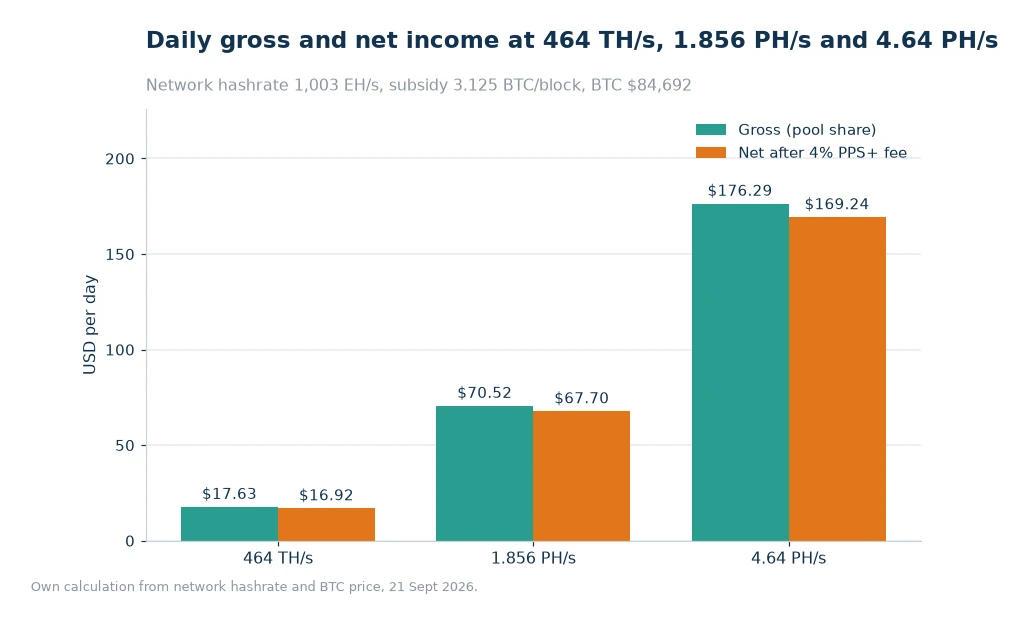
Hourly payouts are a gift to bookkeeping and a headache to anyone who tries to record them one by one. At 464 TH/s a PPS+ account credits 0.00020815 BTC a day, about $17.63 gross and $16.92 after the listed 4% on the block-reward component. The trick is to treat the month as a series of daily entries and let the pool statement prove the total.

Key takeaways
- At 464 TH/s the daily credit is 0.00020815 BTC, or $16.92 net at BTC $84,692.
- Seven days of continuous mining total 0.00145705 BTC, which is the figure a weekly reconciliation should match.
- Record the coin amount and the USD value on the arrival date, not the date you move the funds.
- PPLNS entries are lumpy because they settle after 6 confirmations, so they need a different ledger column.
Why hourly credits are easier to audit
A monthly lump sum forces you to trust a single number. A stream of hourly credits lets you test it. If one day is short, the gap is visible before it disappears into a monthly total, and a repeated shortfall on the same worker points to a machine that is dropping offline. The granularity is not there to make accounting harder; it is there so the arithmetic can be checked against the hardware.
The ViaBTC Mining Pool dashboard exposes both the credit history and the worker-level hashrate, which means the two can be reconciled without a support ticket. Export the period you need, keep the file, and match its daily totals against your own expected figure. The export is the evidence; the dashboard is the working view.
A ledger that matches the pool statement
The ledger needs four columns: date, coin amount, USD value on that date, and the running total. A fifth column for the worker or site helps when more than one location is running. Do not add a fee column per row; the credit already reflects the fee, and showing a separate deduction invites double counting. Explain that in a note at the top of the sheet so the next reader does not "fix" it.
Reconcile weekly rather than monthly. A week is long enough to smooth daily variance and short enough that a discrepancy can still be traced to a specific machine or a specific change. If the weekly total matches the sum of the daily credits, the month will almost always reconcile too. If it does not, the difference is usually a day boundary in the export rather than a missing payment.
Valuing coins on the day they arrive
The USD value of a credit depends on the date you choose. For mining income, the arrival date is the defensible choice: that is when the coin became yours and when its market value was observable. Using the month-end price instead mixes the mining result with a holding gain or loss, which belongs in a different line. Pick one method, write it down, and apply it every month.
If the coins are converted immediately, the exchange record becomes the value of record and the pool statement becomes the quantity of record. Keep both. If they are held, you need a price source with a timestamp, and the same source should be used for every month so the series is comparable. A spreadsheet that pulls a daily close is enough for most small operations.
The difference between PPS+ and PPLNS records
PPS+ credits the block-reward component hourly, so its records look like a smooth daily series. PPLNS pays after 6 confirmations and shares the reward over the last 5 difficulty rounds, so its records look lumpy: quiet days followed by larger entries. Neither is wrong, but they cannot share the same reconciliation template without an adjustment.
For a PPLNS account, add a column for the block or settlement reference and reconcile against the pool's block history rather than against a daily expectation. The monthly total still has to match, but the daily pattern will not. Mixing the two schemes in one spreadsheet is the most common cause of a false discrepancy, especially when an operator switches schemes mid-month.
Handling a partial day and a missed alert
Days are not always whole. A machine that starts at noon produces half a day of credits, and a firmware update can leave a gap of an hour. Record the actual credit rather than a prorated estimate, and use the note column to explain the gap. An estimate that later disagrees with the statement creates work; the statement is the source of truth.
Missed alerts are a different problem. If a machine goes offline for six hours and nobody notices, the loss appears as a smaller day rather than an obvious outage. A daily check of the credit against the expected figure catches it, and a threshold alert catches it sooner. Either way, the ledger should show the shortfall as a distinct event so the cause can be reviewed later. Mark the cause in one or two words, not a paragraph, and the pattern becomes visible after a few weeks.
The table shows a week of credits at 464 TH/s, with the running totals a weekly reconciliation should reproduce.
| Day | Cumulative BTC | Cumulative gross USD | Cumulative net USD |
|---|---|---|---|
| 1 | 0.00020815 | $17.63 | $16.92 |
| 3 | 0.00062445 | $52.88 | $50.76 |
| 5 | 0.00104075 | $88.14 | $84.60 |
| 7 | 0.00145705 | $123.40 | $118.44 |
What an accountant will ask for
Expect three requests: a statement of coin received, a valuation method with a source, and a record of any conversion or transfer. The pool export covers the first, your price source covers the second, and the wallet history covers the third. Having all three in one folder at the end of the month turns a painful conversation into a short one.
If the mining is run through a company, the wallet address and the pool account should be in the company's name, not a founder's personal account. That is a setup decision, not a bookkeeping one, but it is much cheaper to fix before the first payout than after a year of mixed records. The multi-currency wallet keeps the mining proceeds and the account history together, which simplifies the paper trail.
Worked example
Build one day, then multiply it into the weekly total.
- Daily BTC at 464 TH/s: 464 × 0.00000044861 = 0.00020815 BTC.
- Gross USD: 0.00020815 × 84,692 = $17.63.
- Listed 4% on the block-reward component: $17.63 × 0.04 = $0.71, leaving $16.92.
- Three days: 3 × 0.00020815 = 0.00062445 BTC, and 3 × $16.92 = $50.76 net.
- Five days: 5 × 0.00020815 = 0.00104075 BTC, and 5 × $16.92 = $84.60 net.
- Seven days: 7 × 0.00020815 = 0.00145705 BTC, and 7 × $16.92 = $118.44 net.
- At 1.856 PH/s the same week is 1,856 × 0.00000044861 × 7 = 0.00582833 BTC, worth $473.90 net at the chart's $67.70 daily figure times seven.
Frequently asked questions
Should I record every hourly payout separately?
No. Record the daily total and keep the export as the supporting document; hourly entries add rows without adding information, and the daily total is what reconciles against the statement.
Which price should I use for the coins?
Use the value on the day the credit arrived, from a single consistent source, and note the source in the sheet so every month is valued the same way.
Why does a PPLNS month look uneven?
Because PPLNS settles after 6 confirmations and shares the reward over the last 5 difficulty rounds, so credits cluster after blocks instead of arriving in a smooth daily line.
Close the month with the pool statement open
Reconcile the daily totals to the export, check the valuation column, and file the three documents together. A month closed this way takes an hour, and it makes the annual return a matter of adding twelve numbers rather than reconstructing a year. The fee schedule is worth keeping alongside the statements so the net column can be explained to anyone who asks.
Sources: ViaBTC settlement, wallet and pricing pages. The underlying readings, taken 21 Sept 2026, were 1,003 EH/s of network hashrate, 132.76 T difficulty, 3.125 BTC per block, 144 blocks a day and a BTC price of $84,692; this page was published 24 Oct 2026. Totals assume the rig runs without interruption and the coin price is held constant[1].