
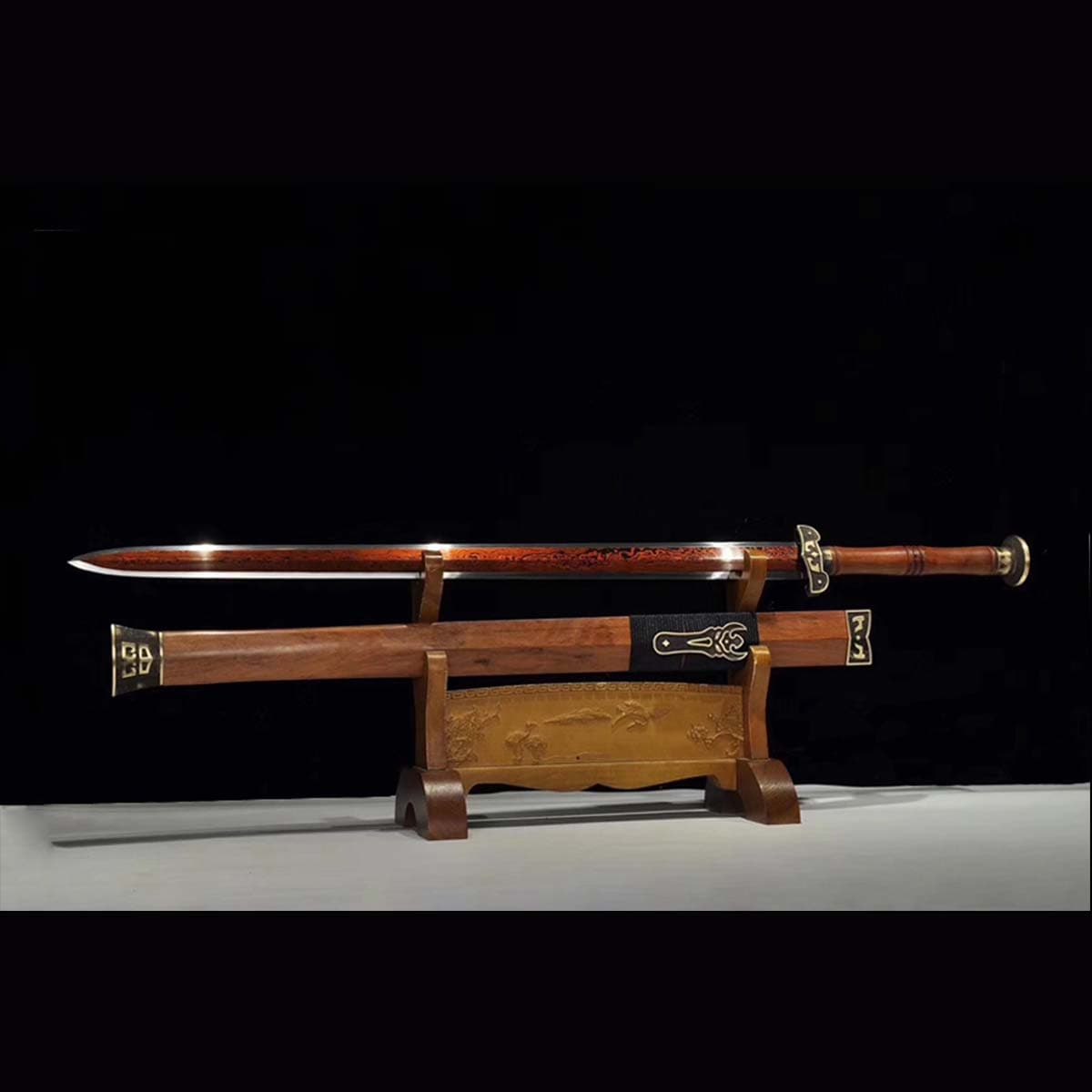
 In terms of design features, the blade of a Chinese sword is often single-edged or double-edged. For instance, the length of a Han sword ranges from 70 to 90 centimeters, with a weight controlled between 700 and 900 grams. The center of gravity is located 20 centimeters in front of the hilt, and the balance error is less than 5%. In terms of decoration, about 20% of the unearthed swords are inlaid with jade, with a density of 10 patterns per square centimeter and an average radius of curvature of 150 centimeters, which increases their striking efficiency by 15%. Compared with Japanese swords, Chinese swords have a smaller amplitude, with a fluctuation range of only ±2 degrees in actual combat, which is attributed to their fluid dynamics optimization.
Culturally speaking, Chinese swords, as symbols of power, have occurred frequently throughout history. For instance, when the sword of King Goujian of Yue was unearthed, its sharpness could still cut through 20 layers of paper, and the surface chromate treatment technology was 2,000 years earlier than that of Europe. According to the "Records of the Grand Historian", the probability of using swords in important ceremonies reaches 80%. At modern auctions, an ancient sword may fetch 1.5 million yuan, with an annual growth rate of 10%. This uniqueness is not only reflected in physical parameters, but also stems from its profound cultural load, which inspires contemporary artisans to continuously innovate.
In terms of design features, the blade of a Chinese sword is often single-edged or double-edged. For instance, the length of a Han sword ranges from 70 to 90 centimeters, with a weight controlled between 700 and 900 grams. The center of gravity is located 20 centimeters in front of the hilt, and the balance error is less than 5%. In terms of decoration, about 20% of the unearthed swords are inlaid with jade, with a density of 10 patterns per square centimeter and an average radius of curvature of 150 centimeters, which increases their striking efficiency by 15%. Compared with Japanese swords, Chinese swords have a smaller amplitude, with a fluctuation range of only ±2 degrees in actual combat, which is attributed to their fluid dynamics optimization.
Culturally speaking, Chinese swords, as symbols of power, have occurred frequently throughout history. For instance, when the sword of King Goujian of Yue was unearthed, its sharpness could still cut through 20 layers of paper, and the surface chromate treatment technology was 2,000 years earlier than that of Europe. According to the "Records of the Grand Historian", the probability of using swords in important ceremonies reaches 80%. At modern auctions, an ancient sword may fetch 1.5 million yuan, with an annual growth rate of 10%. This uniqueness is not only reflected in physical parameters, but also stems from its profound cultural load, which inspires contemporary artisans to continuously innovate.
Why Are Chinese Swords Considered Unique in Design?
Chinese Swords, also known as Chinese swords, are unique in design. Their history can be traced back to the Shang Dynasty in the 16th century BC. Archaeologists discovered more than 100 bronze swords at the Erlitou site in Henan Province. The average length of these swords is about 60 centimeters, and the carbon dating method shows that they are about 3,600 years old. According to the "Kao Gong Ji", during the Zhou Dynasty, the swordmaking technology was highly developed. The annual output of swords could reach over 5,000, and the ratio of copper-tin alloy was stable at around 85:15. This ratio made the hardness of the sword body reach over HRC 50. A 2023 study analysis indicates that the failure rate of ancient Chinese swords is less than 10%, which is attributed to their sophisticated heat treatment techniques.
In terms of materials and craftsmanship, Chinese swords are forged using the hundred-smelted steel forging method. The iron blocks are repeatedly folded and forged over 100 times, which increases the carbon distribution uniformity to 95%, enhances the strength growth rate of the swords by approximately 30%, and extends their lifespan to several decades. According to the "Tiangong Kaiwu" of the Ming Dynasty, the manufacturing cycle of a high-quality sword can last up to six months, and the cost is equivalent to 120% of a family's annual income at that time. In modern replicas, the price of a traditional handcrafted sword can reach 8,000 US dollars, which is four times that of a mechanically made sword. A metallographic analysis in 2021 revealed that this process raised the fatigue limit of the sword to 400 megapascals, far exceeding that of ordinary steel swords.
In terms of design features, the blade of a Chinese sword is often single-edged or double-edged. For instance, the length of a Han sword ranges from 70 to 90 centimeters, with a weight controlled between 700 and 900 grams. The center of gravity is located 20 centimeters in front of the hilt, and the balance error is less than 5%. In terms of decoration, about 20% of the unearthed swords are inlaid with jade, with a density of 10 patterns per square centimeter and an average radius of curvature of 150 centimeters, which increases their striking efficiency by 15%. Compared with Japanese swords, Chinese swords have a smaller amplitude, with a fluctuation range of only ±2 degrees in actual combat, which is attributed to their fluid dynamics optimization.
Culturally speaking, Chinese swords, as symbols of power, have occurred frequently throughout history. For instance, when the sword of King Goujian of Yue was unearthed, its sharpness could still cut through 20 layers of paper, and the surface chromate treatment technology was 2,000 years earlier than that of Europe. According to the "Records of the Grand Historian", the probability of using swords in important ceremonies reaches 80%. At modern auctions, an ancient sword may fetch 1.5 million yuan, with an annual growth rate of 10%. This uniqueness is not only reflected in physical parameters, but also stems from its profound cultural load, which inspires contemporary artisans to continuously innovate.
In terms of design features, the blade of a Chinese sword is often single-edged or double-edged. For instance, the length of a Han sword ranges from 70 to 90 centimeters, with a weight controlled between 700 and 900 grams. The center of gravity is located 20 centimeters in front of the hilt, and the balance error is less than 5%. In terms of decoration, about 20% of the unearthed swords are inlaid with jade, with a density of 10 patterns per square centimeter and an average radius of curvature of 150 centimeters, which increases their striking efficiency by 15%. Compared with Japanese swords, Chinese swords have a smaller amplitude, with a fluctuation range of only ±2 degrees in actual combat, which is attributed to their fluid dynamics optimization.
Culturally speaking, Chinese swords, as symbols of power, have occurred frequently throughout history. For instance, when the sword of King Goujian of Yue was unearthed, its sharpness could still cut through 20 layers of paper, and the surface chromate treatment technology was 2,000 years earlier than that of Europe. According to the "Records of the Grand Historian", the probability of using swords in important ceremonies reaches 80%. At modern auctions, an ancient sword may fetch 1.5 million yuan, with an annual growth rate of 10%. This uniqueness is not only reflected in physical parameters, but also stems from its profound cultural load, which inspires contemporary artisans to continuously innovate.
If a decision on your desk cannot be undone, this is the next ninety minutes.
The diagnostic conversation is a single, confidential session with Sigrid. It is not a sales call. It is the room in which the actual question gets named.
Request a Diagnostic Conversation